< < MC10.5 : MC11.1 : MC11.2 > >
MC11.1: Traditional Field Control Implementation
The Maintenance and Construction Signal Priority service package uses maintenance and construction vehicle to infrastructure communications to allow a maintenance and construction vehicle (e.g., a snow plow or a lane striping vehicle) to request priority at one or a series of intersections. In this implementation, signal priority is based on direct communication between the Maintenance Vehicle and ITS Roadway Equipment
Relevant Regions: Australia, Canada, European Union, and United States
- Enterprise
- Functional
- Physical
- Goals and Objectives
- Needs and Requirements
- Sources
- Security
- Standards
- System Requirements
Enterprise
Development Stage Roles and Relationships
Installation Stage Roles and Relationships
Operations and Maintenance Stage Roles and Relationships
(hide)
| Source | Destination | Role/Relationship |
|---|---|---|
| ITS Roadway Equipment Maintainer | ITS Roadway Equipment | Maintains |
| ITS Roadway Equipment Manager | ITS Roadway Equipment | Manages |
| ITS Roadway Equipment Manager | Maint and Constr Field Personnel | System Usage Agreement |
| ITS Roadway Equipment Owner | ITS Roadway Equipment Maintainer | System Maintenance Agreement |
| ITS Roadway Equipment Owner | ITS Roadway Equipment Manager | Operations Agreement |
| ITS Roadway Equipment Owner | Traffic Management Center Maintainer | Maintenance Data Exchange Agreement |
| ITS Roadway Equipment Owner | Traffic Management Center Owner | Information Exchange Agreement |
| ITS Roadway Equipment Owner | Traffic Management Center User | Service Usage Agreement |
| ITS Roadway Equipment Owner | Traffic Operations Personnel | Application Usage Agreement |
| ITS Roadway Equipment Supplier | ITS Roadway Equipment Owner | Warranty |
| Maint and Constr Center Personnel | Maint and Constr Management Center | Operates |
| Maint and Constr Field Personnel | ITS Roadway Equipment | Operates |
| Maint and Constr Management Center Maintainer | Maint and Constr Management Center | Maintains |
| Maint and Constr Management Center Manager | Maint and Constr Center Personnel | System Usage Agreement |
| Maint and Constr Management Center Manager | Maint and Constr Management Center | Manages |
| Maint and Constr Management Center Owner | Maint and Constr Management Center Maintainer | System Maintenance Agreement |
| Maint and Constr Management Center Owner | Maint and Constr Management Center Manager | Operations Agreement |
| Maint and Constr Management Center Owner | Maint and Constr Vehicle OBE Maintainer | Maintenance Data Exchange Agreement |
| Maint and Constr Management Center Owner | Maint and Constr Vehicle OBE Owner | Information Exchange Agreement |
| Maint and Constr Management Center Owner | Maint and Constr Vehicle OBE User | Service Usage Agreement |
| Maint and Constr Management Center Owner | Maint and Constr Vehicle Operator | Application Usage Agreement |
| Maint and Constr Management Center Supplier | Maint and Constr Management Center Owner | Warranty |
| Maint and Constr Vehicle OBE Maintainer | Maint and Constr Vehicle OBE | Maintains |
| Maint and Constr Vehicle OBE Manager | Maint and Constr Vehicle OBE | Manages |
| Maint and Constr Vehicle OBE Manager | Maint and Constr Vehicle Operator | System Usage Agreement |
| Maint and Constr Vehicle OBE Owner | ITS Roadway Equipment Maintainer | Maintenance Data Exchange Agreement |
| Maint and Constr Vehicle OBE Owner | ITS Roadway Equipment Owner | Expectation of Data Provision |
| Maint and Constr Vehicle OBE Owner | ITS Roadway Equipment User | Service Usage Agreement |
| Maint and Constr Vehicle OBE Owner | Maint and Constr Center Personnel | Application Usage Agreement |
| Maint and Constr Vehicle OBE Owner | Maint and Constr Field Personnel | Application Usage Agreement |
| Maint and Constr Vehicle OBE Owner | Maint and Constr Management Center Maintainer | Maintenance Data Exchange Agreement |
| Maint and Constr Vehicle OBE Owner | Maint and Constr Management Center Owner | Information Exchange Agreement |
| Maint and Constr Vehicle OBE Owner | Maint and Constr Management Center User | Service Usage Agreement |
| Maint and Constr Vehicle OBE Owner | Maint and Constr Vehicle OBE Maintainer | System Maintenance Agreement |
| Maint and Constr Vehicle OBE Owner | Maint and Constr Vehicle OBE Manager | Operations Agreement |
| Maint and Constr Vehicle OBE Supplier | Maint and Constr Vehicle OBE Owner | Warranty |
| Maint and Constr Vehicle Operator | Maint and Constr Vehicle OBE | Operates |
| Traffic Management Center Maintainer | Traffic Management Center | Maintains |
| Traffic Management Center Manager | Traffic Management Center | Manages |
| Traffic Management Center Manager | Traffic Operations Personnel | System Usage Agreement |
| Traffic Management Center Owner | ITS Roadway Equipment Maintainer | Maintenance Data Exchange Agreement |
| Traffic Management Center Owner | ITS Roadway Equipment Owner | Information Exchange Agreement |
| Traffic Management Center Owner | ITS Roadway Equipment User | Service Usage Agreement |
| Traffic Management Center Owner | Maint and Constr Field Personnel | Application Usage Agreement |
| Traffic Management Center Owner | Traffic Management Center Maintainer | System Maintenance Agreement |
| Traffic Management Center Owner | Traffic Management Center Manager | Operations Agreement |
| Traffic Management Center Supplier | Traffic Management Center Owner | Warranty |
| Traffic Operations Personnel | Traffic Management Center | Operates |
Functional
This service package includes the following Functional View PSpecs:
Physical
The physical diagram can be viewed in SVG or PNG format and the current format is SVG.SVG Diagram
PNG Diagram
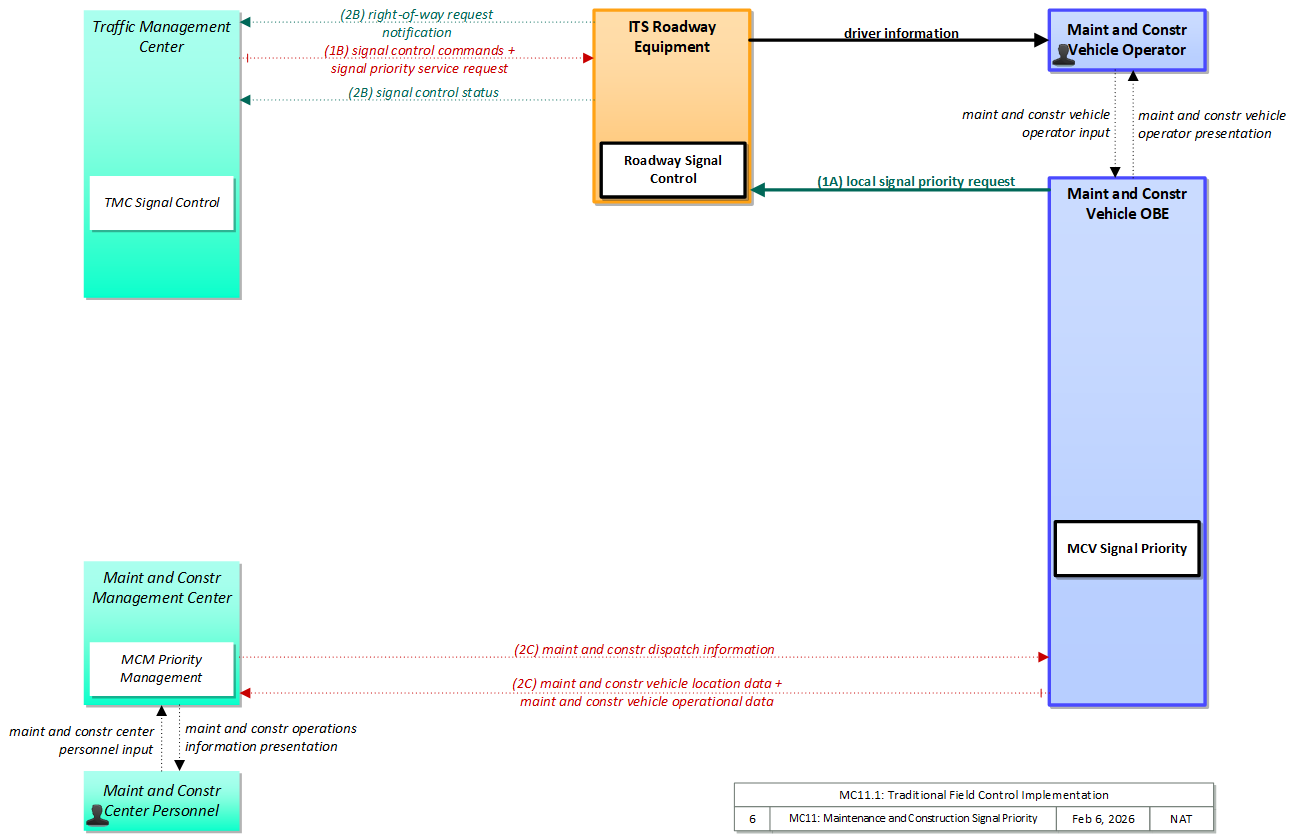

Includes Physical Objects:
| Physical Object | Class | Description |
|---|---|---|
| ITS Roadway Equipment | Field | 'ITS Roadway Equipment' represents the ITS equipment that is distributed on and along the roadway that monitors and controls traffic and monitors and manages the roadway. This physical object includes traffic detectors, environmental sensors, traffic signals, highway advisory radios, dynamic message signs, CCTV cameras and video image processing systems, grade crossing warning systems, and ramp metering systems. Lane management systems and barrier systems that control access to transportation infrastructure such as roadways, bridges and tunnels are also included. This object also provides environmental monitoring including sensors that measure road conditions, surface weather, and vehicle emissions. Work zone systems including work zone surveillance, traffic control, driver warning, and work crew safety systems are also included. |
| Maint and Constr Center Personnel | Center | The people that directly interface with a Maintenance and Construction Management Center. These personnel interact with fleet dispatch and management systems, road maintenance systems, incident management systems, work plan scheduling systems, and work zone management systems. They provide operator data and command inputs to direct system operations to varying degrees depending on the type of system and the deployment scenario. |
| Maint and Constr Management Center | Center | The 'Maint and Constr Management Center' monitors and manages roadway infrastructure construction and maintenance activities. Representing both public agencies and private contractors that provide these functions, this physical object manages fleets of maintenance, construction, or special service vehicles (e.g., snow and ice control equipment). The physical object receives a wide range of status information from these vehicles and performs vehicle dispatch, routing, and resource management for the vehicle fleets and associated equipment. The physical object participates in incident response by deploying maintenance and construction resources to an incident scene, in coordination with other center physical objects. The physical object manages equipment at the roadside, including environmental sensors and automated systems that monitor and mitigate adverse road and surface weather conditions. It manages the repair and maintenance of both non-ITS and ITS equipment including the traffic controllers, detectors, dynamic message signs, signals, and other equipment associated with the roadway infrastructure. Weather information is collected and fused with other data sources and used to support advanced decision support systems. The physical object remotely monitors and manages ITS capabilities in work zones, gathering, storing, and disseminating work zone information to other systems. It manages traffic in the vicinity of the work zone and advises drivers of work zone status (either directly at the roadside or through an interface with the Transportation Information Center or Traffic Management Center physical objects.) Construction and maintenance activities are tracked and coordinated with other systems, improving the quality and accuracy of information available regarding closures and other roadway construction and maintenance activities. |
| Maint and Constr Vehicle OBE | Vehicle | The 'Maint and Constr Vehicle OBE' resides in a maintenance, construction, or other specialized service vehicle or equipment and provides the processing, storage, and communications functions necessary to support highway maintenance and construction. All types of maintenance and construction vehicles are covered, including heavy equipment, supervisory vehicles, unmanned remote controlled field maintenance robots, and sensory platforms that may be wheeled or low altitude aerial vehicles (e.g. drones, balloons). The MCV OBE provides two-way communications between drivers/operators and dispatchers and maintains and communicates current location and status information. A wide range of operational status is monitored, measured, and made available, depending on the specific type of vehicle or equipment. A snow plow for example, would monitor whether the plow is up or down and material usage information. The Maint and Constr Vehicle OBE may also contain capabilities to monitor vehicle systems to support maintenance of the vehicle itself. A separate 'Vehicle OBE' physical object supports the general vehicle safety and driver information capabilities that apply to all vehicles, including maintenance and construction vehicles. The Maint and Constr Vehicle OBE supplements these general capabilities with capabilities that are specific to maintenance and construction vehicles. |
| Maint and Constr Vehicle Operator | Vehicle | The operator of maintenance, construction, or other specialized service vehicles or equipment. Represents the maintenance and construction vehicle operators. The operator provides input specific to maintenance and construction vehicle operations, including the status of maintenance actions. Information provided to the operator includes dispatch requests and maintenance and construction actions to be performed. |
| Traffic Management Center | Center | The 'Traffic Management Center' monitors and controls traffic and the road network. It represents centers that manage a broad range of transportation facilities including freeway systems, rural and suburban highway systems, and urban and suburban traffic control systems. It communicates with ITS Roadway Equipment and Connected Vehicle Roadside Equipment (RSE) to monitor and manage traffic flow and monitor the condition of the roadway, surrounding environmental conditions, and field equipment status. It manages traffic and transportation resources to support allied agencies in responding to, and recovering from, incidents ranging from minor traffic incidents through major disasters. |
Includes Functional Objects:
| Functional Object | Description | Physical Object |
|---|---|---|
| MCM Priority Management | 'MCM Priority Management' monitors maintenance schedule performance and generates requests for priority on routes and at certain intersections to facilitate time-critical maintenance operations like winter maintenance. It may coordinate with the Traffic Management Center to provide priority along the selected route. It also coordinates with the Maintenance and Construction Vehicle OBE to monitor and manage local priority requests at individual intersections. | Maint and Constr Management Center |
| MCV Signal Priority | 'MCV Signal Priority' provides the capability for maintenance and construction vehicles to determine eligibility for priority and request signal priority at signalized intersections, ramps, and interchanges through short range communication with traffic control equipment at the roadside. | Maint and Constr Vehicle OBE |
| Roadway Signal Control | 'Roadway Signal Control' includes the field elements that monitor and control signalized intersections. It includes the traffic signal controllers, detectors, conflict monitors, signal heads, and other ancillary equipment that supports traffic signal control. It also includes field masters, and equipment that supports communications with a central monitoring and/or control system, as applicable. The communications link supports upload and download of signal timings and other parameters and reporting of current intersection status. It represents the field equipment used in all levels of traffic signal control from basic actuated systems that operate on fixed timing plans through adaptive systems. It also supports all signalized intersection configurations, including those that accommodate pedestrians. In advanced, future implementations, environmental data may be monitored and used to support dilemma zone processing and other aspects of signal control that are sensitive to local environmental conditions. | ITS Roadway Equipment |
| TMC Signal Control | 'TMC Signal Control' provides the capability for traffic managers to monitor and manage the traffic flow at signalized intersections. This capability includes analyzing and reducing the collected data from traffic surveillance equipment and developing and implementing control plans for signalized intersections. Control plans may be developed and implemented that coordinate signals at many intersections under the domain of a single Traffic Management Center and are responsive to traffic conditions and adapt to support incidents, preemption and priority requests, pedestrian crossing calls, etc. This may include adaptive traffic control systems (ATCS) that adjust signal timings based on traffic conditions, demand, and system capacity. It also supports all signalized intersection configurations, including those that accommodate pedestrians. | Traffic Management Center |
Includes Information Flows:
| Information Flow | Description |
|---|---|
| driver information | Regulatory, warning, guidance, and other information provided to the driver to support safe and efficient vehicle operation. |
| local signal priority request | Request from a vehicle to a signalized intersection for priority/preemption at that intersection. |
| maint and constr center personnel input | User input from maintenance and construction center personnel including routing information, scheduling data, dispatch instructions, device configuration and control, resource allocations, alerts, incident and emergency response plan coordination. |
| maint and constr dispatch information | Information used to dispatch maintenance and construction vehicles, equipment, and crews and information used to keep work zone crews informed. This information includes routing information, traffic information, road restrictions, incident information, environmental information, decision support information, maintenance schedule data, dispatch instructions, personnel assignments, alert notifications, and corrective actions. |
| maint and constr operations information presentation | Presentation of maintenance and construction operations information to center personnel. This information includes maintenance resource status (vehicles, equipment, and personnel), work schedule information, work status, road and weather conditions, traffic information, incident information and associated resource requests, security alerts, emergency response plans and a range of other information that supports efficient maintenance and construction operations and planning. |
| maint and constr vehicle location data | The current location and related status (e.g., direction and speed) of the maintenance/construction vehicle. |
| maint and constr vehicle operational data | Data that describes the maintenance and construction activity performed by the vehicle. Operational data includes materials usage (amount stored and current application rate), operational state of the maintenance equipment (e.g., blade up/down, spreader pattern), vehicle safety status, and other measures associated with the operation of a maintenance, construction, or other special purpose vehicle. Operational data may include basic operational status of the vehicle equipment or a more precise record of the work performed (e.g., application of crack sealant with precise locations and application characteristics). |
| maint and constr vehicle operator input | User input from field personnel including current maintenance and construction status information as well as on-board device control. |
| maint and constr vehicle operator presentation | Information presented to maintenance and construction field personnel including vehicle routing and traffic information, road restrictions, environmental information, decision support information, maintenance schedules, dispatch instructions, maintenance personnel assignments, vehicle maintenance information, work zone status information, and corrective actions. |
| right-of-way request notification | Notice that a request has occurred for signal prioritization, signal preemption, pedestrian call, multi-modal crossing activation, or other source for right-of-way. |
| signal control commands | Control of traffic signal controllers or field masters including clock synchronization. |
| signal control status | Operational and status data of traffic signal control equipment including operating condition and current indications. |
| signal priority service request | A service request for vehicle priority issued to a traffic signal controller. The request includes the priority level, and may include other parameters such as the desired time and duration of service, and the intended travel path through the intersection. This flow also allows the originator to cancel a previously issued request for priority. |
Goals and Objectives
Associated Planning Factors and Goals
| Planning Factor | Goal |
|---|---|
| E. Protect and enhance the environment, promote energy conservation, improve the quality of life, and promote consistency between transportation improvements and State and local planned growth and economic development patterns; | Protect/Enhance the Environment |
Associated Objective Categories 
| Objective Category |
|---|
| System Efficiency: Energy Consumption |
Associated Objectives and Performance Measures
| Objective | Performance Measure |
|---|---|
| Reduce excess fuel consumed due to congestion by X percent by year Y. | Excess fuel consumed (total or per capita). |
Needs and Requirements
| Need | Functional Object | Requirement | ||
|---|---|---|---|---|
| 01 | Traffic Management needs to collect data from maintenance management in order to support traffic signal system optimization for maintenance and construction vehicles. | MCM Priority Management | 01 | The maintenance/construction vehicle shall provide maintenance vehicle operational data to the center. |
| 02 | The center shall make signal priority requests to the signal control center. | |||
| 03 | The center shall accept vehicle location data from maintenance/construction vehicles. | |||
| 07 | The center shall accept signal priority status information from the signal control center. | |||
| 02 | Traffic Management needs to process traffic and maintenance and construction vehicle data in order to provide maintenance and construction vehicle signal priority for the efficient movement of maintenance and construction vehicles. | MCM Priority Management | 06 | The center shall accept input from center personnel related to dispatch and instruction of maintenance/construction vehicles. |
| 03 | Traffic Management needs to communicate with field equipment to provide maintenance and construction vehicle signal priority commands to the intersection. | Roadway Signal Control | 09 | The field element shall report current intersection signal timing information to roadside equipment for transmission to connected vehicles. |
| TMC Signal Control | 01 | The center shall remotely control traffic signal controllers. | ||
| 10 | The center shall adjust signal timing in response to a signal prioritization, signal preemption, pedestrian call, multi-modal crossing activation, or other requests for right-of-way. | |||
| 04 | The Maintenance and Construction Vehicle Operator needs to progress through his arterial route safely and efficiently. | MCM Priority Management | 01 | The maintenance/construction vehicle shall provide maintenance vehicle operational data to the center. |
| 02 | The center shall make signal priority requests to the signal control center. | |||
| 05 | The center shall provide dispatch instructions to maintenance/construction vehicles. | |||
| 06 | The center shall accept input from center personnel related to dispatch and instruction of maintenance/construction vehicles. | |||
| 07 | The center shall accept signal priority status information from the signal control center. | |||
| MCV Signal Priority | 01 | The maintenance/construction vehicle shall provide operational information to the vehicle operator, including routing and traffic information and maintenance/construction-specific information relevant to ongoing or upcoming taskings. | ||
| 02 | The maintenance/construction vehicle shall accept signalized intersection status information from roadside controllers. | |||
| 03 | The maintenance/construction vehicle shall roadway geometry information from roadside controllers. | |||
| 04 | The maintenance/construction vehicle shall send priority requests to traffic signal controllers at intersections, pedestrian crossings, and multimodal crossings on the roads (surface streets) and freeway (ramp controls) network that enable the vehicle to | |||
| 05 | The maintenance/construction vehicle shall accept dispatch information from maintenance centers. | |||
| 06 | The maintenance/construction vehicle shall send schedule deviation data and status of priority requests to the vehicle operator and provide the capability for the vehicle operator to control the priority system. | |||
| 07 | The maintenance/construction vehicle shall accept input from field equipment describing the status of signal priority requests. | |||
| 08 | The maintenance/construction vehicle shall accept input from the vehicle operator, regarding operational status and device control. | |||
| Roadway Signal Control | 13 | The field element shall receive requests for maintenance and construction vehicle signal priority. | ||
| 14 | The field element shall report current maintenance and construction vehicle priority status to the center. | |||
| 05 | Maintenance and Construction management needs to be able to be able to monitor the schedule performance of maintenance/construction vehicles so that it might request signal priority when needed. | MCM Priority Management | 03 | The center shall accept vehicle location data from maintenance/construction vehicles. |
| 04 | The center shall provide information to the center personnel indicating maintenance/construction vehicle operating conditions and status. | |||
| 05 | The center shall provide dispatch instructions to maintenance/construction vehicles. | |||
| 06 | The center shall accept input from center personnel related to dispatch and instruction of maintenance/construction vehicles. | |||
Related Sources
| Document Name | Version | Publication Date |
|---|---|---|
| None |
Security
In order to participate in this service package, each physical object should meet or exceed the following security levels.
| Physical Object Security | ||||
|---|---|---|---|---|
| Physical Object | Confidentiality | Integrity | Availability | Security Class |
| ITS Roadway Equipment | Moderate | High | Moderate | Class 3 |
| Maint and Constr Management Center | Moderate | Moderate | Moderate | Class 2 |
| Maint and Constr Vehicle OBE | Moderate | Moderate | Moderate | Class 2 |
| Traffic Management Center | Moderate | High | Moderate | Class 3 |
In order to participate in this service package, each information flow triple should meet or exceed the following security levels.
| Information Flow Security | |||||
|---|---|---|---|---|---|
| Source | Destination | Information Flow | Confidentiality | Integrity | Availability |
| Basis | Basis | Basis | |||
| ITS Roadway Equipment | Maint and Constr Vehicle Operator | driver information | Not Applicable | High | Moderate |
| This data is sent to all drivers and is also directly observable, by design. | This is the primary signal trusted by the driver to decide whether to go through the intersection and what speed to go through the intersection at; if it’s wrong, accidents will happen. | If the lights are out you have to get a policeman to direct traffic – expensive and inefficient and may cause a knock-on effect due to lack of coordination with other intersections. | |||
| ITS Roadway Equipment | Traffic Management Center | right-of-way request notification | Low | Moderate | Moderate |
| This can be reasonably guessed based on observing the ITS RE’s environment. It is obvious when a bus approaches an intersection. | Invalid messages could lead to an unauthorized user gaining signal priority at an intersection. This could also be used to delay traffic, which could lead to a financial impact on the community. However, the traffic signal will have controls in place to ensure that it does not display an illegal configuration (such as green in every direction). | Even if all of the Right-of-way Requests are not passed along from an ITS RE, the intersection will still operate as normal. There are other existing methods to assist a right-of-way requesting vehicle safely traveling through an intersection, such as lights and sirens, which prevent this from being a HIGH. DISC: THEA and NYC believe this to be LOW: "not necessary for the app to work; can cope with not having immediately available data" | |||
| ITS Roadway Equipment | Traffic Management Center | signal control status | Low | High | Moderate |
| The current conditions of an ITS RE are completely observable, by design. | This influences the TMC response to a right-of-way request. It should be as accurate as the right-of-way request themselves. For some applications (ISIG) this need only be moderate. Per THEA: info needs to be accurate and should not be tampered to enable effective monitoring and control by the TMC. DISC: THEA believes this to be MODERATE: "info needs to be accurate and should not be tampered to enable effective monitoring and control by the TMC; should be as accurate as the right of way request". NYC:TMC doesn’t play an active role in this application, i.e. even if the information contained in this flow were incorrect, it is unlikely to affect the outcome of this application one way or the other. On some applications NYC has this MODERATE though. RES: This value can obviously change a lot depending on the application context. | The TMC will need the current status of the ITS RE in order to make an educated decision. If it is unavailable, the system is unable to operate. However, a few missed messages will not have a catastrophic impact. From NYC: TMC doesn’t play an active role in this application, i.e. even if it is unavailable, it is unlikely to affect the outcome of this application one way or the other. RES: This value can change a lot depending on the application context. | |||
| Maint and Constr Center Personnel | Maint and Constr Management Center | maint and constr center personnel input | High | High | High |
| Direct interactions between personnel and systems in a backoffice environment are effectively protected by physical means, so long as the interaction is in a dedicated facility. If this interaction is virtual (i.e. ,the MCMC is not directly in front of the MCMC Personnel, like in a cloud-based system) then the user's input requires some degree of obfuscation depending on sensitivity of information. Given that this could include information about compromised or ineffectual systems, including security systems, the potential for damage is high. Thus, HIGH. | Backoffice operations flows should generally be correct and available as these are the primary interface between operators and system. | Backoffice operations flows should generally be correct and available as these are the primary interface between operators and system. | |||
| Maint and Constr Management Center | Maint and Constr Center Personnel | maint and constr operations information presentation | Not Applicable | Moderate | Moderate |
| System maintenance flows should have some protection from casual viewing, as otherwise imposters could gain illicit control over field equipment | Information presented to backoffice system operators must be consistent or the operator may perform actions that are not appropriate to the real situation. | The backoffice system operator should have access to system operation. If this interface is down then control is effectively lost, as without feedback from the system the operator has no way of knowing what is the correct action to take. | |||
| Maint and Constr Management Center | Maint and Constr Vehicle OBE | maint and constr dispatch information | Moderate | Moderate | Moderate |
| Maintenance vehicle dispatch and routing information is predictive of maintenance vehicle location, and should be protected from hostile actors, as they may use this information for target acquisition or selection or damage assessment, for example. | Maintenance vehicle dispatch instructions need to be correct and timely so that road maintenance activities are performed when and where they should be. Corruption of this information would cost time and money and may impact mobility. | Maintenance vehicle dispatch instructions need to be correct and timely so that road maintenance activities are performed when and where they should be. Corruption of this information would cost time and money and may impact mobility. | |||
| Maint and Constr Vehicle OBE | ITS Roadway Equipment | local signal priority request | Not Applicable | Moderate | Low |
| This information can be observed. | nly approved vehicles should be allowed to make these requests to the RSE. A corrupted request may lead to a transit vehicle not receiving a green light after requesting it. In this case, this may lead to traffic delays. If an unapproved vehicle is able to forge these requests, they may cause larger scale traffic delays. | If the RSE does not receive any requests, the vehicle may not receive the priority it requested. In the worst case scenario the transit vehicle would be forced to wait at some lights until they turned green. It would be more useful for a device to support this application, and only have some messages received, than to not support this application at all. | |||
| Maint and Constr Vehicle OBE | Maint and Constr Management Center | maint and constr vehicle location data | Moderate | Moderate | Moderate |
| This is effectively a tracking flow, which if intercepted would provide a third party with the ability to track maintenance and construction vehicles, which could enable nefarious and illegal activities. | Corruption, unavailability or unauthorized manipulation of this data could lead to a lack of understanding of maintenance vehilce locations. This could negatively effect coordinated actions such as roadway treatment and snow removal, compromising mobility. It could also negatively impact the safety of the vehicle operator. | Corruption, unavailability or unauthorized manipulation of this data could lead to a lack of understanding of maintenance vehilce locations. This could negatively effect coordinated actions such as roadway treatment and snow removal, compromising mobility. It could also negatively impact the safety of the vehicle operator. | |||
| Maint and Constr Vehicle OBE | Maint and Constr Management Center | maint and constr vehicle operational data | Moderate | Moderate | Moderate |
| Contains information indicating the activity of the maintenance vehicle, which if public could be used against the vehicle or the infrastructure, depending on the hostile party's intent. | Status information needs to be timely and correct or the dispatcher may issue additional instructions, costing time and money. | Status information needs to be timely and correct or the dispatcher may issue additional instructions, costing time and money. | |||
| Maint and Constr Vehicle OBE | Maint and Constr Vehicle Operator | maint and constr vehicle operator presentation | Moderate | High | High |
| System maintenance flows should have some protection from casual viewing, as otherwise imposters could gain illicit control over the MCV. | System maintenance flows are the primary interface between field personnel and field equipment, and must present accurate data or inappropriate maintenance actions may be taken. | System maintenance flows are the primary interface between field personnel and field equipment, and must present accurate data or inappropriate maintenance actions may be taken. | |||
| Maint and Constr Vehicle Operator | Maint and Constr Vehicle OBE | maint and constr vehicle operator input | Not Applicable | Moderate | High |
| Observation of control or status information is unlikely to have any value to a third party; actions of field personnel should be observable anyway. | Any driver/operator interaction with vehicle systems needs some assurance of correctness; corruption of this information could lead to unexpected vehicle behavior which poses a limited safety risk. | Without direct local control of vehicle systems the vehicle is essentially uncontrolled. | |||
| Traffic Management Center | ITS Roadway Equipment | signal control commands | Moderate | High | Moderate |
| Control flows, even for seemingly innocent devices, should be kept confidential to minimize attack vectors. While an individual installation may not be particularly impacted by a cyberattack of its sensor network, another installation might be severely impacted, and different installations are likely to use similar methods, so compromising one leads to compromising all. DISC: NYC believes this to be LOW: "The result of this will be directly observable." | Invalid messages could lead to an unauthorized user gaining control of an intersection. This could also be used to bring traffic to a standstill, which could lead to a large financial impact on the community. DISC: NYC believes this to be MODERATE: The signal timing is critical to the intersection operation; incorrect signal timing can lead to significant congestion and unreliable operation; while unsafe operation is controlled by the cabinet monitoring system, attackers could “freeze” the signal or call a preemption. RES: This will vary depending on the application and implementation. | These messages are important to help with preemption and signal priority applications. Without them, these applications mayl not work. However, if these signals are not received, the ITS RE will continue to function using its default configuration. The TMC should have an acknowledgement of the receipt of a message. DISC: NYC blieves this to be LOW: TMC doesn’t play an active role in this application, i.e. even if it is unavailable, it is unlikely to affect the outcome of this application one way or the other. RES: This will vary depending on the application and implementation. | |||
| Traffic Management Center | ITS Roadway Equipment | signal priority service request | Not Applicable | Moderate | Low |
| There is no sensitive or confidential information within this messages. Additionally, it could be inferred by observing either the presence of a priority-requesting vehicle near an intersection, or the effect on the timing of the intersection. This is also transmitted as a result of broadcast data. | The TMC is transmitting a request to the ITS RE on behalf of a priority-requesting vehicle. It should only be making requests on behalf of an approved vehicle. A corrupted request may lead to a vehicle not receiving a green light after requesting it. In this case, this may lead to traffic delays. If an unapproved vehicle is able to forge these requests, they may cause larger scale traffic delays. | If the ITS RE does not receive any requests, the vehicle may not receive the priority it requested. In the worst case scenario the vehicle would be forced to wait at some lights until they turned green. It would be more useful for a device to support this application, and only have some messages received, than to not support this application at all. | |||
Standards
The diagram here shows the primary standards associated with the physical objects and information flows in this service package. Click on the standard # to go to the page explaining that standard in more detail. The tables that follow the diagram list the standards associated with the information flows in this service package that should drive development decisions. Click on the standard name for more information from the Communications View about a particular standard, including the solutions and information flow triples associated with the standard and any gaps or overlaps. This table is based primarily on standards used in North America. For information concerning standards and communications solutions in other regions consult the Communications View.
This material should be considered 'draft for review' and may change separately from ARC-IT version revisions. The date on the diagram relates to the date of the physical service package diagram on which this is based; standards-related information should be considered up-to-date as of the 'last updated' date on this page.
Communication Standards: Standards associated with data, message or dialog definitions, communications protocols and management and security of data exchanges. All standards here are also illustrated in information flow triple communications view diagrams.
| Name | Title |
|---|---|
| ITS Application Entity | |
| CTI 4001 RSU | Roadside Unit (RSU) Standard |
| NTCIP 1202 Signal Controller Objects | NTCIP Object Definitions for ASC |
| NTCIP 1204 Weather Station Objects | NTCIP Environmental Sensor Station Interface Standard |
| NTCIP 1210 Signal System Master Objects | NTCIP Objects for Signal System Masters |
| NTCIP 1211 Signal Control Priority Objects | NTCIP Objects for SCP |
| Proprietary | Proprietary |
| Facilities Layer | |
| Bundle: ISO 15784-2 | Intelligent transport systems (ITS) -- Data exchange involving roadside modules communication -- Part 2: Centre to field device communications using SNMP |
| Security Entity | |
| IETF RFC 6353 TLS for SNMP | Transport Layer Security (TLS) Transport Model for the Simple Network Management Protocol (SNMP) |
| IETF RFC 9456 TLS Updates for SNMP | Updates to the TLS Transport Model for SNMP |
| IP Security Alternatives | Internet Protocol Security Alternatives |
| Secure Session Alternatives | Secure Session Alternatives |
| Management Entity | |
| Bundle: SNMPv3 MIB | SNMPv3 & Networking MIBs |
| NTCIP 1201 Global Objects | NTCIP Global Object (GO) Definitions |
| Networking and Transport Layer | |
| Internet Transport Alternatives | Internet Transport Alternatives |
| IP Alternatives | Internet Protocol Alternative Set |
| Access Layer | |
| Field SubNet Alternatives | Field SubNet Alternatives |
| Wireless Internet Alternatives (NA) | Wireless Internet Alternatives according to North American standards |
Physical Standards: Standards associated with device physical, environmental or performance requirements.
The following table lists the standards associated with physical objects in this service package. Click on the standard name for more information about a particular standard.
| Name | Title |
|---|---|
| ISO 24100 Probe Vehicle Data Protection | Intelligent transport systems -- Basic principles for personal data protection in probe vehicle information services |
| ITE 5201 ATC | Advanced Transportation Controller |
| ITE 5202 ATC Model 2070 | Model 2070 Controller Standard |
| ITE 5301 ATC ITS Cabinet | Intelligent Transportation System Standard Specification for Roadside Cabinets |
| ITE 5401 ATC API | Application Programming Interface Standard for the Advanced Transportation Controller |
| NEMA TS 8 Cyber and Physical Security | Cyber and Physical Security for Intelligent Transportation Systems |
| NEMA TS2 Traffic Controller Assemblies | Traffic Controller Assemblies with NTCIP Requirements |
| SAE J3361 Antenna requirements | V2X Antenna Coverage and Test Requirements for US FHWA Class 1 and Class 3-13 Class Vehicles |
| SAE J5001 OBU Standard | Onboard Unit Standard for Connected Vehicles |
Service-Level Standards: Standards associated service package structure, messaging patterns, user needs, requirements or similar systems-engineering content that describe one or more use cases satisfied by the service package.
No service-level standards have been identified for this service package.
System Requirements
| No System Requirements |